Contents
Nucleophilic substitution (SN) reaction
- Nucleophiles are electron rich atoms or group of atoms which attack on electron deficient centre during chemical reaction. Nucleophiles are the negatively charged species or neutral species having electron rich centre.
- Any substitution reaction that involves replacing of an atom or a functional group by a nucleophile is called nucleophilic substitution reaction.
- During nucleophilic substitution reaction in haloalkanes (alkyl halides) , the nucleophile attacks the haloalkane and replaces the halogen atom.
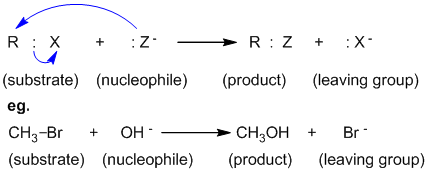

- There are two main types of nucleophilic substitution reactions – SN2 and SN1 reaction.
SN2 reaction
SN2 reaction is also known as bimolecular nucleophilic substitution reaction. Such reactions are generally shown by primary haloalkanes. For example, hydrolysis of ethyl bromide with aq.KOH.


Kinetics of SN2 reaction:
Rate of SN2 reaction depends upon the concentration of both substrate (i.e. alkyl halide) and nucleophile. Thus the reaction follows second order kinetics since both the reactants are present in rate determining step.


Mechanism and Stereochemistry of SN2 reaction:
- The mechanism of SN2 reaction involves a single step. Therefore, the breaking of carbon – halogen (C – X) bond and making of carbon – nucleophile (C – OH) bond occurs simultaneously.
- It is assumed that the nucleophile attacks the carbon atom attached to the halogen atom from the side opposite to the halogen (i.e. backside attack). As a result a transition state (activated complex) is formed in which carbon atom is partially bonded to both nucleophile and leaving group (halogen atom).
- Activated complex is unstable and it is a species having high energy content. Finally, bromine leaves the molecule as a bromide ion and hydroxide ion forms a covalent bond with carbon giving alcohol having inverted configuration is formed as the product.
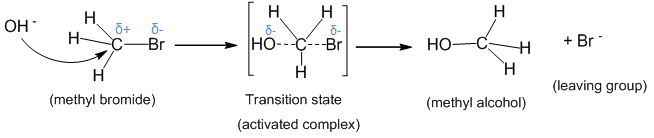

Energy profile diagram of SN2 reaction:


Reactivity of alkyl halides towards SN2 reaction:
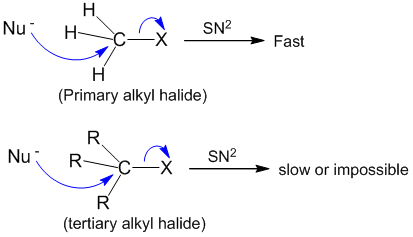
The order of reactivities of alkyl halides towards the SN2 reaction is:


The reaction is faster when the alkyl group of the substance is methyl. When the hydrogen atoms of methyl group are replaced by bulkier alkyl groups, the increased crowding around central atom hinders the attack of nucleophile. This is called steric hindrance. Greater the steric hindrance, slower is the reaction.

SN1 reaction
SN1 reaction is also known as unimolecular nucleophilic substitution reaction. Such reaction are generally shown by secondary and tertiary haloalkanes. For example, hydrolysis of tertiary butyl bromide with aq. KOH.


Kinetics of SN1 reaction:
Rate of SN1 reaction depends upon the concentration of alkyl halide and is independent of the concentration of nucleophile. Thus the reaction follows first order kinetics.
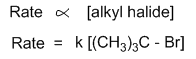

Mechanism of SN1 reaction:
SN1 reaction occurs in two steps.
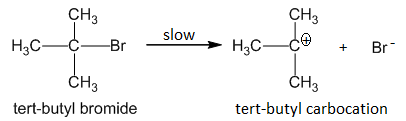
Step I : In first step, the carbon-halogen bond of tertiary butyl bromide slowly breaks heterolytically to form an intermediate carbocation i.e. tert-butyl carbocation.

Step II : The carbocation formed combines rapidly with nucleophile i.e. OH– to give tertiary butyl alcohol.


- Slow step is the rate determining step, thus, step (I) is the rate determining step.
Energy profile diagram of SN1 reaction:


Stereochemistry of SN1 reaction:
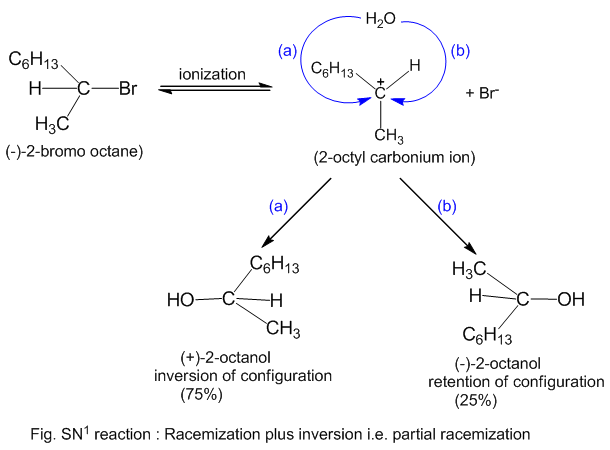
In SN1 reaction, carbocations are formed as the intermediate which are trigonal and planar. Carbocation has a flat structure so that nucleophile can attack it from either side (i.e. front or back) resulting in the formation of two products, one with retention of configuration and other with inversion of configuration. Thus, if the alkyl halide is optically active (i.e. when halogen carrying carbon is chiral), the product would be racemic mixture and optically inactive. However, in actual practice, the product as a whole is not racemic. Usually there is a larger proportion of molecules with inverted configuration than of same configuration.
For example, when (-)-2-bromooctane is hydrolyzed by SN1 reaction, partially racemized product is formed.

Reactivity of alkyl halides towards SN1 reaction:
The rate of SN1 reaction depends on the stability of carbocation formed. Therefore, the order of reactivities of alkyl halides towards the SN1 reaction is:


A tertiary carbocation is more stable than a secondary carbocation which is more stable than a primary carbocation. Greater the stability of the carbocation, greater will be the ease of formation of carbocation, and hence faster will be the rate of the reaction.
Comparision (differences) between SN1 and SN2 reaction
The major differences between SN1 and SN2 reactions are as follows:


References
- Finar, I. L., Organic Chemistry, Vol. I and Vol. II, Prentice Hall, London, 1995.
- Ghosh, S.K., Advanced General Organic Chemistry, Second Edition, New Central Book Agency Pvt. Ltd., Kolkatta, 2007.
- Morrison, R.T. , Boyd, R.N., Organic Chemistry, Sixth edition, Prentice-Hall of India Pvt. Ltd., 2008.
- https://pubs.acs.org/doi/pdf/10.1021/acs.jpca.8b11579?src=recsys
- https://www.organic-chemistry.org/namedreactions/nucleophilic-substitution-sn1-sn2.shtm