

Contents
- What are alicyclic compounds?
- Bicyclic compounds
- Preparation of alicyclic compounds
- Baeyer’s strain Theory / Angle strain theory
- Factors affecting the stability of conformations
- Equatorial and axial bonds in cyclohexane
- Different conformations of cyclohexane and their stability
- Conformations of monosubstituted cyclohexane
- Conformation of disubstituted cyclohexane
- References
What are alicyclic compounds?
The cyclic hydrocarbons whose properties are similar to open chain aliphatic hydrocarbons (alkanes, alkenes and alkynes) are called alicyclic compounds. Alicyclic compounds contain one or more rings but do not show aromatic characters. Example:


Nomenclature of alicyclic compounds
- Cyclo prefix is used.


- If substituent is present : Substituent bearing C-atom gets lowest number.


- If multiple bond is present : Multiple bond gets lowest number.


- If functional group is present:
Priority order : Functional group > Multiple bond > Substituent


Bicyclic compounds
Compounds containing two fused rings that share two or more C-atoms are known as bicyclic compounds.
Such compounds are named as bicycloalkanes. Eg.


Note:
If substituents or multiple bonds are present, names are written along with their locants.
The numbering begins from a bridge head carbon through the longest bridge first.


Note:
Polycyclic compounds of unusual shape are named according to shapes. Eg.


Preparation of alicyclic compounds
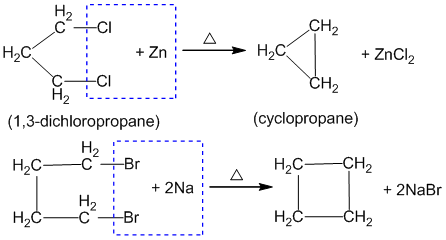
1. From dihalogen compounds:
When dihalogen compounds are treated with sodium or zinc metal, the corresponding cycloalkanes are formed. Examples:

2. From diels-alder reaction:
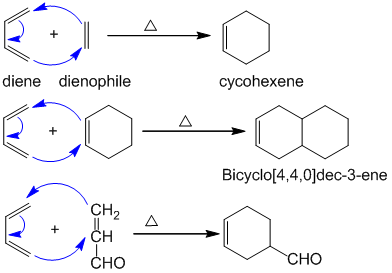
- In this reaction, two unsaturated molecules combine to form a cyclic compound.
- It involves the reaction between a diene and a dienophile to produce cyclic product.
Examples:

3. By reduction of aromatic compound:


Baeyer’s strain Theory / Angle strain theory
In 1885 Adolf Baeyer proposed a theory to explain the relative stability of the cycloalkanes, which is called Baeyer’s strain theory. The theory is based on the following assumptions:
- All cyclic rings are planar i.e. carbon atoms of ring lie in the same plane.
- Since carbon atom is tetrahedral in nature, bond angle should be 109028’. Any deviation from this value develops strain on the ring (molecule). Such strain is called angle strain.
- The stability of a molecule decreases with increasing the angle strain in the ring.
- The angle strain is expressed in terms of the angle deviation(d) and can be calculated by using following relationship:


Let us calculate the angle strain of some alicyclic rings on the basis of the Baeyer’s strain assumption,
- In cyclopropane, the three carbon atoms are situated at the corners of an equilateral triangle. Thus each of the C-C-C bond angle in cyclopropane is 600. Therefore, for cyclopropane:


This value represents the angle strain in cyclopropane.
- In cyclobutane, four carbon atoms are situated at the corners of a square. Thus each of the C-C-C bond angle is 900. Therefore, for cyclobutane:


This value represents the angle strain in cyclobutane.
- In cyclopentane, the C-C-C bond angle is 1080. Hence, the angle strain is:


- But, the bond angle of regular cyclohexane is 1200, which is larger than the tetrahedral value, then the value of angle strain is:


- Similarly, in cycloheptane, d = -9033’.
The above results are listed in the following table:
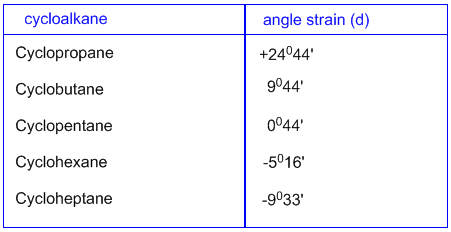

- From the above data, it can be seen that the angle strain is maximum in cyclopropane. Therefore, according to Baeyer’s strain theory, cyclopropane should be most unstable molecule. The experimental results also support this conclusion. For example, cyclopropane undergoes ring opening reaction (with H2, Br2, HBr) in order to release the strain and gives the more stable open chain compounds.
- The deviation of the bond angle in cyclobutane is lesser than in cyclopropane. Therefore, it should be more stable than cyclopropane. The experimental observations also support this conclusion.
- There is minimum angle strain in cyclopentane and hence it should be most stable. The low reactivity of cyclopentane support this conclusion.
- The value of angle strain(d) is high in cyclohexane than in cyclopentane. Thus it should be less stable than cyclopentane. The angle strain continuously increases with the increase in the number of carbon atoms in the ring. Thus, according to this theory, the stability of higher cycloalkanes should decrease gradually. In this way, Baeyer suggested that ring smaller or larger than cyclopentane are unstable.
- But cyclohexane and higher cycloalkanes are found to be quite stable. They do not undergo ring opening reactions. Therefore, this theory is not valid (applicable) for cyclohexane and the higher cycloalkanes , though it satisfactorily explains the stability of lower cycloalkanes.
Strainless rings: [Sache-Mohr theory of strainless rings]
- Baeyer assumed the cyclic rings were flat i.e. the ring carbon atoms lie in the same plane. This assumption was false, therefore this theory became wrong and can’t be applied to larger rings.
- Actually, cyclohexane and other larger rings are not flat, but are puckered so that each bond angle can be 109028’. Consequently the ring becomes strainless and stable.
For example, the cyclohexane can exist in two non-planar strainless puckered (folded) forms.


Factors affecting the stability of conformations
1. Angle strain: The sp3 hybridized carbon has 109028’, sp2 hybridized has 1200 and sp hybridized has 1800 bond angle. Any deviation from the normal bond angle is known as angle strain. The greater the angle strain in the molecule, the less is the stability.
2. Torsional strain: Repulsion between bonding electron pairs is called torsional strain.
The staggered conformation is more stable due to less torsional strain. Any deviation from staggered conformation develops instability.
3. Steric strain or Vander Waal’s strain : If two (non-bonded) atoms or groups are brought closer, repulsive force develops between them, which is called Vander Waal’s strain or steric strain. Greater the steric strain greater is the instability.
[Steric strain is the repulsive interaction that occurs when atoms are forced closer together than their atomic radii allow. It is the result of trying to force two atoms to occupy the same space.]4. Dipole-dipole interaction: Non- bonded substituents on C-C bond may undergo dipole-dipole interactions. If the non-bonded atoms have partial positive and negative charge densities (opposite charge), an attractive force generates between them which brings stability to the conformation.
Equatorial and axial bonds in cyclohexane
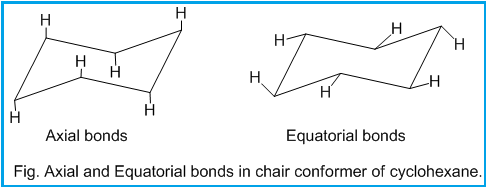
- Although the cyclohexane ring is not flat, we can consider that the carbon atoms lie roughly in a plane. In such conformation, we can see two types of hydrogens. Six hydrogens lying on the plane and six hydrogens lying above and below the plane of the ring.
- The bonds holding the hydrogen that are in the plane of the ring and situated along the equator of the ring are called equatorial bonds.
- Similarly, the bonds holding the hydrogen that are above and below the plane and situated along an axis i.e. perpendicular to the plane of the ring are called axial bonds.
- In chair conformation, each carbon atom has one equatorial and one axial bond.

Different conformations of cyclohexane and their stability
Cyclohexane is unstable in planar form. Hence, it has non-planar puckered conformation. It can have different conformations such as- chair, boat, half chair and twist boat conformations.
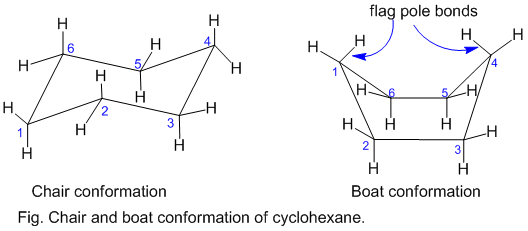

In chair form, there are six axial and six equatorial C – H bonds. All the carbon-carbon bonds are staggered. Thus, the chair form is free from torsional strain and steric strain. Therefore, chair form has minimum P.E. and is most stable.
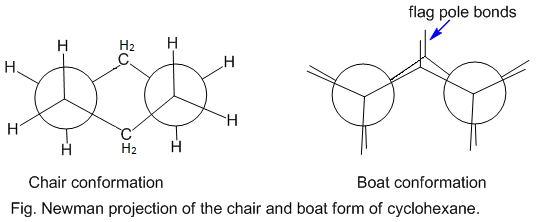

- Chair conformation changes to boat conformation due to C-C single bond rotation.
- In boat form, there are four axial and four equatorial bond. There are flag pole bonds on the carbon atoms 1 and 4. There is steric strain (Vander-Waals strain) due to crowding between flag pole hydrogens. In this conformation, carbon-carbon bonds are eclipsed which creates maximum torsional strain too. Thus boat conformation is less stable than chair conformation and lies 7.1Kcal energy above the chair conformation.
- In twist boat form, two flag pole hydrogens are farther which decreases steric strain. At the same time, torsional strain is also decreased. Thus, twist boat conformation is more stable than boat conformation by 1.6KCalmol-1, but is less stable than chair conformation by 5.5 KCalmol-1.
- Between the chair conformation and twist boat conformation, there is a transition state conformation, which is called half chair conformation. It has both angle strain and torsional strain and hence it lies 11Kcal above the chair conformation and is least stable.


Conformations of monosubstituted cyclohexane
(Equatorial and axial methyl cyclohexane):
If one H-atom of cyclohexane is replaced by a bulky –CH3 group, two possible chair conformations are possible. In one conformation the –CH3 group occupies an axial position and in other –CH3 group occupies an equatorial position.


When –CH3 group is axial, it is very close to the two axial H-atoms on the same side of the molecule attached to C3 and C5 atoms i.e. there is crowding and repulsion among these groups which is called 1,3-diaxial interaction.
- Due to 1,3-diaxial interaction, steric strain develops in the molecule, which makes the axial conformation less stable.
But there is no repulsion when –CH3 is equatorial because –CH3 group points away from its nearest hydrogens, which makes the equatorial conformation more stable.
In other words, two axial hydrogen atoms are more closer to axial –CH3 than any hydrogen atoms to equatorial –CH3. Hence, conformation of methyl cyclohexane with equatorial –CH3 is more stable than the conformation of methyl cyclohexane with axial –CH3.


Conformation of disubstituted cyclohexane
(eg. 1,3-dimethyl cyclohexane)
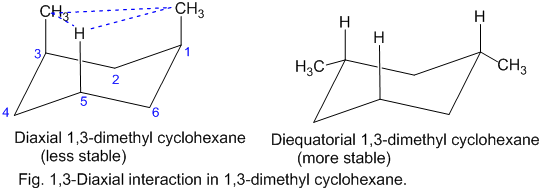


In 1,3-dimethyl cyclohexane having two –CH3 groups in axial position, there is repulsive 1,3-diaxial interaction between two –CH3 groups which creates steric strain. Therefore diaxial 1,3-dimethyl cyclohexane is less stable.
References
- Bahl, B.S., A., Advanced Organic Chemistry, S. Chand and company Ltd, New Delhi, 1992.
- Finar, I. L., Organic Chemistry, Vol. I and Vol. II, Prentice Hall, London, 1995.
- Ghosh, S.K., Advanced General Organic Chemistry, Second Edition, New Central Book Agency Pvt. Ltd., Kolkatta, 2007.
- Morrison, R.T. , Boyd, R.N., Organic Chemistry, Sixth edition, Prentice-Hall of India Pvt. Ltd., 2008.
- March, j., Advanced Organic Chemistry, Fourth edition, Wiley Eastern Ltd. India, 2005.
- https://pubchem.ncbi.nlm.nih.gov/compound/Cyclohexane#:~:text=Cyclohexane%20is%20an%20alicyclic%20hydrocarbon,and%20a%20volatile%20organic%20compound.
- https://www.sciencedirect.com/topics/chemical-engineering/cyclohexane